
#32: Sloan Asakura
A conversation on dream, ritual and presence.
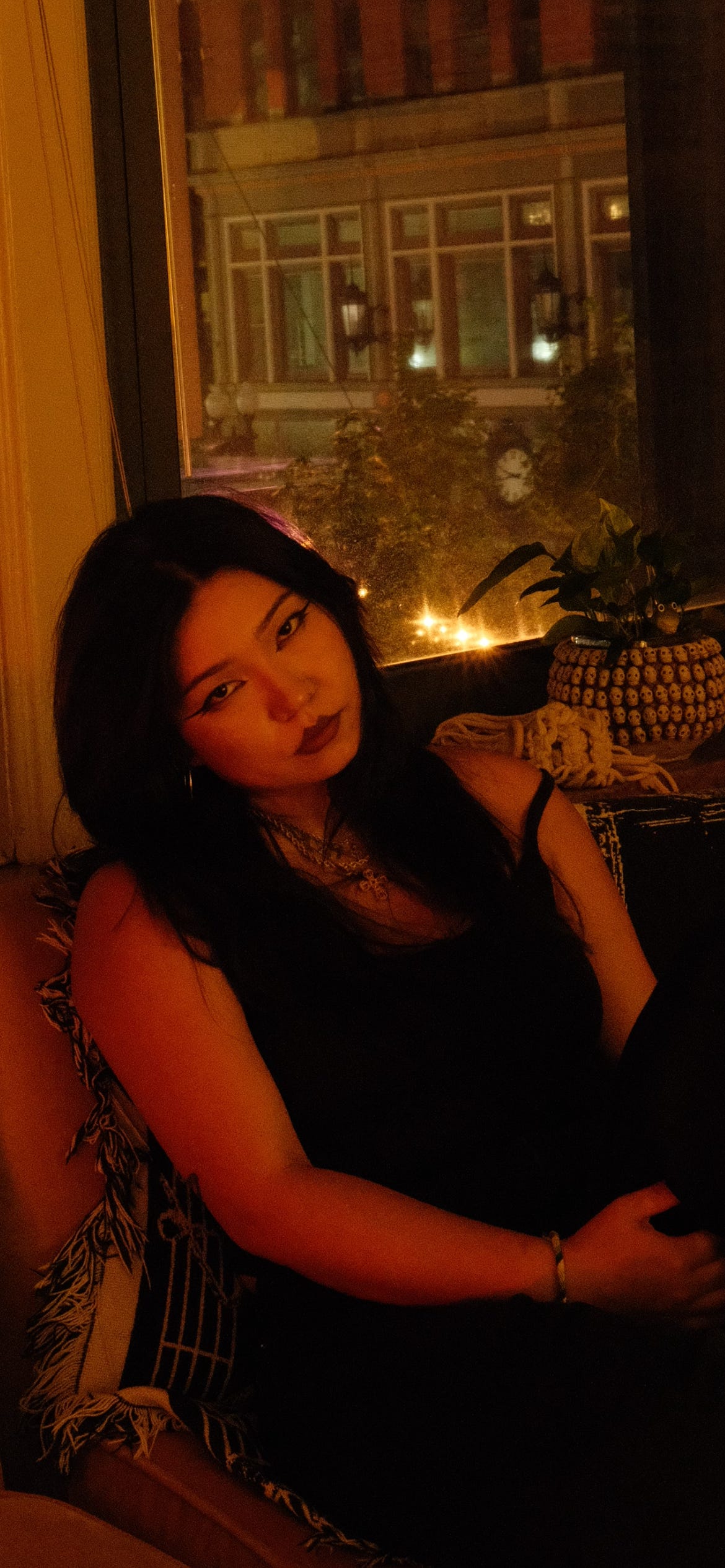
Sloan Asakura writes from the place where dream and waking life touch. What follows is a conversation about presence, return and the quiet work of staying connected.
Note: Sloan Asakura is the winner of the 2024 Memoir Excerpt & Essay Contest from CRAFT Literary for their piece Excerpt from Window.
Who are you and how do you express your creativity? Or: who are you and how do you describe your art?
I’m a poet and memoirist primarily, and a photographer and visual artist subsequently thanks to poetry and memoir.
Describing my work is a task— if I were to summarize, I’d say my work deals in parallelisms and unreliable realities, transgenerational and post-memory, the inhabited body as landscape, and radical joy. If I were to take the long way, I’d say I’m concerned with dream, which is not to say surrealism, but to say what is real when you’re asleep is just as real as when you’re awake. These things aren’t separate for me.
I’m also concerned with shadows, not in the Jungian way, but moreover in the parallel self which exists without the details and its tie to your very being—your physical body must cast a shadow when there is light to cast it, making it proof of existence and existence not meaning life but rather meaning presence, which in some myth might mean soul.
I’m also concerned with return, its spatialities, migration & displacement, the hereditary effect bombing, and whether or not all of these things are a type of memory, and transformation by way of such. I’m also concerned with sensation and write from the body and ritual, often in acts of mimicry. Much of my work revolves around these core concepts. Although, in photography, I find a different type of manifestation of these concepts which is less of the question and more of the answer—how might I capture what I can’t? Well, I’m doing it.
What keeps you coming back to creative work? Why is it worth doing?
People! I do it because I love people. I mean this in the broadest sense. People meaning artists, people meaning scientists, people meaning my dear friends, people meaning strangers, people meaning ancestors, people meaning animals who were supposed to be human, people meaning my neighbor beside me on the airplane who I’ll know only for these three hours. All art, for me, comes back to my love of the world and everyone in it.
I can’t help but notice the beauty and I need somewhere to put it. Art can hold it for me. And art can connect me to someone beyond time—I can turn it upside down, and there is a memory of someone I love on the other side.
I feel a gravitational pull to art—I always have. Whether it was making or admiring, I was always reaching into it and finding fragments of myself and people I know in it and I think that’s really the heart of it. I started making art so I could have a chance at survival, and for me, survival was always about connection. You’re translating something so someone can reach in and find themselves there somehow, and for that brief moment you’re connected to that person by way of something you made in an attempt to connect to yourself. All our strings are funny that way, the way they’re never just ours.
What legacy do you hope to leave with your art?
I hope people can walk away with an understanding of the resilience of the human experience inside of art.
Art is a big enough container to hold all you’ve gone through. And all you’ve gone through is surely not just your own personal experiences, but also the experiences you’ve inherited. These are heavy burdens for the human body, but poetry and art is where we can put these down.
I hope people can walk away from my work with that in mind and have the urge (and hopefully follow it) to create more art..
What are your biggest challenges when it comes to maintaining a steady creative practice, and how have you overcome them?
I didn’t write for three years. And a lot of this had to do with circumstances that were robbing me of my love for the world, which was grief and other types of suffering. During all that time, I made the decision to apply for fellowships and residencies and focus on my professional development because that was what I could do for myself. And thank the universe for that decision because it helped me maintain focus and get back to a place where I could start writing again!
So nowadays, I’m very much an advocate of just doing what you can. Following your curiosities and obsessions into oblivion while you have them and allowing yourself rest when you need it, but always doing something for your creative heart to maintain faith in itself.
When I have a hard time writing, I dedicate myself to reading, or to creating something new like a string sculpture or drawing or taking myself on a photo walk because all these things will inevitably spur something. These are similar to the ritual, which is another way that I walk myself into creative practice.
What advice would you offer someone who wants to start or refresh their creative practice in a new way?
Incorporating the ritual is vital. I recently attended one of CA Conrad’s talks and they discussed what the ritual really does and I think it’s something a lot of folks don’t consider. Many people feel they can only write in times of high or low emotions, but CA Conrad made an interesting point that it isn’t that you can only write during these times, but that these times create a focal point of your attention and by proxy a lot of space around this focal point—and you can write into that space. And the ritual is another way to create that type of attention and space, which allows you to write into it.
Tell us about the role of mentorship and community support in your creative life — who has been instrumental in your journey?
I wouldn’t be a poet if it wasn’t for my mentors. I didn’t even believe I could be a poet. I took classes with Nancy Pagh, Ely Shipley, and Jane Wong and they all believed in me more than I believed in myself and saw a future I couldn’t see. And without them, I’d never have pursued a career in poetry. I owe everything, all the joy I have right now, to those three.
Whatever I become, whatever poetry leads me to, is because I had mentors who read my work and were willing to argue with me when I said I wasn’t a poet or that I’d never publish poetry. I needed their belief. I needed their adamancy. And they gave it like it was easy but to me, it was a miracle!
Endless gratitude. And now, I’m doing my MFA at Brown University and my cohort has been phenomenal. Everything is easier knowing they’re rooting for me. I’ve had such great luck, to be surrounded by such gracious and wonderful writers.
Who is your dream mentor?
I won’t say because you never know who can walk into your life and change everything, or what effect someone unexpected will have on you. Once, my Uber driver changed my life — her name was Margarita and she was a mentor I never knew I needed!
For poetry, I’ve been lucky to have had the opportunity already to work with so many writers I admire and I hope that continues on and on. But beyond poetry, I’d love to talk to my four year-old self. I think she has much to teach me.
With love and intention,
Cara
P.S. You’re receiving this newsletter because you’ve chosen to support Archipel — thank you.
Reader support keeps this writing alive and allows projects like the DEW Scholarship to grow in real, tangible ways.
Subscribe and stay in the current with us
Visit my Support page
Make a small offering on Buy Me a Coffee
Thank you for being a part of this ecosystem.